



Going back to school can be daunting. We're here to make it easier. From flexible course schedules with mostly online classes to faculty who are leaders in the field of medical imaging and who understand the needs of adult learners, a bachelor's degree in medical imaging from Emory University School of Medicine is well within reach.
Use the links below to find answers to frequently asked questions about financial aid (we've got it), the Emory campus, gaining certification in advanced modalities, career planning, and more.
Frequently Asked Questions
Who is the RT to BMSc Program for?
The program is for those who already hold a diploma, degree, or certificate in medical imaging and certification as a radiographic technologist (RT). The program is not for students who are new to medical imaging.
I am working full time. Can I still complete the program?
Yes! Busy professionals do very well in our program. Most courses are offered online and many are self-paced which makes it easier for working professionals to fit coursework into their busy schedule.
How long will it take to earn my degree?
You could earn your degree in as little as a year if you are a full-time student. Part-time students could earn a BMSc degree in about two years. Individual progress may vary.
What about financial aid?
We know education costs are a concern. Many employers, including Emory Healthcare, offer tuition reimbursement or other programs to help cover the costs of tuition. Talk with your employer about their tuition reimbursement/assistance options. You may also qualify for need-based financial aid such as student loans and grants. Scholarships are available from the Georgia Society of Radiologic Technologists (GSRT), the Atlanta Society of Radiologic Technologists, the American Society of Radiologic Technologists (ASRT), and the Association of Educators in Imaging and Radiologic Sciences (AEIRS). You also can find additional scholarship opportunities through Fastweb, a free scholarship search platform.
Does the BMSc degree guarantee I earn more money?
Salaries are set by employers and they use a range of criteria when creating their pay scales. Check with your employer about their policies regarding salary adjustments. What the BMSc degree really does is open doors a wider range of career opportunities, many of which offer higher salaries and more room for advancement if you hold a bachelor's degree or advanced registries.
How is the program accredited?
Emory University is accredited by the Commission on Colleges of the Southern Association of Colleges and Schools to award degrees at the associate, bachelor’s, master’s, and doctoral levels. This organization can be contacted at the following address:
Commission on Colleges
Southern Association of Colleges and Schools
1866 Southern Lane
Decatur, GA 30033-4907
(404) 679-4501
The Emory Medical Imaging Program is accredited by
Joint Review Committee on Education in Radiologic Technology (JRCERT)
20 N. Wacker Drive
Suite 2850
Chicago, IL 60606-3182
Phone: (312) 704-5300
Fax: (312) 704-5304
E-mail: mail@jrcert.org
The program's current accreditation award is eight (8) years. General program accreditation information can be found on the JRCERT website including the current accreditation award letter.
Program Resources
Click for access to the following important program resources:
| BMSc Clinical Handbook | University Policies |
| BMSc Student Handbook | Academic Calendar 2025-2026 |
| BMSc Program Effectiveness Data | MIP Calendar 2025-2026 |
Emory University Resources
Professional Associations
- Atlanta Society of Radiologic Technologists
- Georgia Society of Radiologic Technologists
- American Society of Radiologic Technologists
- American Registry of Radiologic Technologists
- Joint Review Committee on Education in Radiologic Technology
- The Association of Educators in Imaging and Radiologic Sciences
- The Association for Medical Imaging Management
- Section for Magnetic Resonance Technologists
- Aunt Minnie
Lambda Nu Honor Society
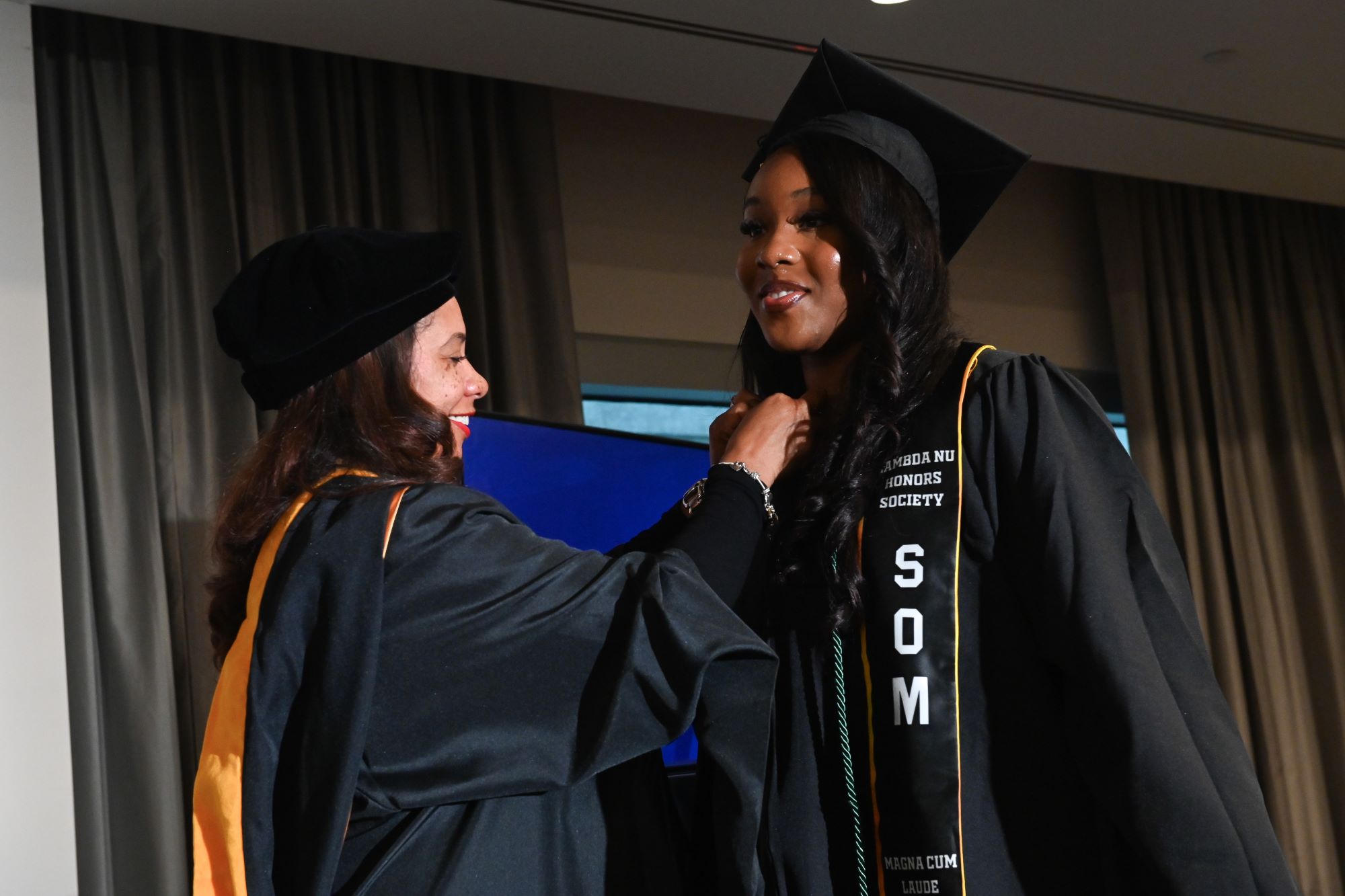
The Emory University Medical Imaging Program’s chapter of the Lambda Nu Honor Society invites alumni, current students, clinical instructors, and faculty to join the Georgia Sigma Theta chapter. Lambda Nu (LN) is a national honor society for the radiologic and imaging sciences.
Its objectives are as follows:
- Foster scholarship at the highest academic level;
- Promote research and investigation in the radiologic and imaging sciences; and
- Recognize exemplary scholarship.
Student Eligibility
- Professional course cumulative GPA of 3.5 or higher on a 4.0 scale after three full-time semesters (or equivalent) of a professional program;
- Enrollment in a radiologic or imaging sciences program as a full-time student for at least one year or equivalent (part-time students are eligible after the fourth semester); and
- Evidence of professional commitment beyond minimum requirements of the program, including, but not limited to the following:
- GPA higher than Chapter minimum.
- Actively pursuing an independent research project.
- Active membership in a professional organization, as evidenced by
- Holding office or committee appointments;
- Preparing for a presentation of a professional paper or poster; and/or
- Preparing for competition in a Quiz-Bowl or other academic competitions
- Clinical‑based employment in a radiologic or imaging sciences field.
The cost is a one-time fee of $40.00 for students. Download the Emory Student Application.
Alumni Eligibility
- Graduated with a 3.5 or higher GPA on a 4.0 scale; and
- Evidence of professional commitment beyond minimum requirements of the program, including, but not limited to:
- GPA higher than Chapter minimum.
- Actively pursuing an independent research project.
- Active membership in a professional organization, as evidenced by
- Holding office or committee appointments;
- Preparing for the presentation of a professional paper or poster; and/or
- Preparing for competition in a Quiz-Bowl or other academic competitions.
- Clinical‑based employment in a radiologic or imaging sciences field.
The cost is a one-time fee of $40.00 for alumni. Download the Alumni Application.
If you meet the requirements and are interested in being considered for induction into the Lambda Nu Society, please complete the application and send it along with a check made payable to Emory University Lambda Nu Honor Society to the following address:
Emory University Medical Imaging Program
Lambda Nu Honor Society
Attn: Jacki Harmon
531 Asbury Cir, N112
Atlanta, Ga. 30322
Mailstop 1600-002-1AA
Career Information
Medical imaging is a dynamic and growing field. The BMSc degree opens doors to an exciting range of opportunities that include management, education, and advanced imaging.
For general career planning information, visit the American Society of Radiologic Technologists Career Center
To learn about career opportunities with Emory Healthcare, visit Emory Healthcare Careers and click on Radiology. To learn more about benefits for Emory Healthcare employees, visit Emory Healthcare Benefits.
Emory is an equal opportunity employer, and qualified applicants will receive consideration for employment without regard to race, color, religion, sex, national origin, disability, protected veteran status or other characteristics protected by state or federal law. Emory University does not discriminate in admissions, educational programs, or employment, including recruitment, hiring, promotions, transfers, discipline, terminations, wage and salary administration, benefits, and training. Students, faculty, and staff are assured of participation in university programs and in the use of facilities without such discrimination. Emory University complies with Section 503 of the Rehabilitation Act of 1973, the Vietnam Era Veteran's Readjustment Assistance Act, and applicable executive orders, federal and state regulations regarding nondiscrimination, equal opportunity, and affirmative action (for protected veterans and individuals with disabilities). Inquiries regarding this policy should be directed to the Emory University Department of Equity and Civil Rights Compliance, 201 Dowman Drive, Administration Building, Atlanta, GA 30322. Telephone: 404-727-9867 (V) | 404-712-2049 (TDD).
Emory University is committed to providing reasonable accommodations to qualified individuals with disabilities upon request. To request this document in an alternate format or to request a reasonable accommodation, please contact the Department of Accessibility Services at 404-727-9877 (V) | 404-712-2049 (TDD). Please note that one week's advance notice is preferred.
Non-Discrimination Policy
Emory University is an equal opportunity/equal access/affirmative action employer fully committed to achieving a diverse workforce and complies with all applicable federal and Georgia state laws, regulations, and executive orders regarding nondiscrimination and affirmative action in its programs and activities. Emory University does not discriminate on the basis of race, color, religion, ethnic or national origin, gender, genetic information, age, disability, sexual orientation, gender identity, gender expression, and veteran's status. Inquiries should be directed to the Office of Equity and Inclusion, 201 Dowman Drive, Administration Bldg, Atlanta, GA 30322. Telephone 404/727-9867 (V) 404/712-2049 (TDD)