



For Kevin Barber, MD, ophthalmology has never been limited to the operating room. His career has been defined by a mission to expand access to sight-saving care across borders, to strengthen training for physicians in underserved regions, and to build durable systems that ensure continuity long after visiting surgeons depart.
Dr. Barber’s path began at the University of Florida, where he completed medical school, followed by a surgical internship at the Mayo Clinic. He then pursued a residency in ophthalmology at Emory University, a period that shaped his professional identity and deepened his global perspective. After completing residency in 2005, he entered private practice in Gainesville, Georgia, while continuing to teach residents at the VA and Grady hospitals.
He later returned to central Florida, and in 2018 co-founded the Advanced Center for Eyecare Global (ACE Global), an organization dedicated to building long-term solutions for preventable blindness. Rather than focusing solely on short-term surgical campaigns, ACE Global emphasizes education, equipping local physicians with the training and resources needed to serve their own communities.
“While at Emory, I was able to take part in one of their global ophthalmology programs – and that was just beginning.”
Even before his clinical career began, Barber had been drawn to international medical service. As a pre-medical student in Honduras, he observed the transformative power of cataract surgery in low-resource settings. Patients who had lived in blindness due to lack of access were restored to sight within minutes, an experience that left a lasting impression. Additional medical missions during training—to Nicaragua, Ecuador, and Ethiopia—reinforced his belief that ophthalmology could meaningfully address global inequities.
“In the early years, we approached global ophthalmology through surgical missions—working intensely for a week or two, performing as many procedures as possible, and then leaving,” Barber said. “But no matter how many surgeries we completed, countless patients remained untreated. The model was not sustainable. Education and training offer a solution that lasts.”
ACE Global has established its strongest presence in Honduras, where historically only two residents graduated annually from the nation’s sole ophthalmology training program, serving a population of nearly 11 million. By developing fellowship programs in anterior segment surgery, oculoplastics, and soon retina and pediatrics, ACE Global has created a framework in which local physicians graduate with extensive surgical experience and remain to teach future trainees.
“Instead of doing the surgery myself, I now sit in the co-pilot seat,” Barber explained. “The priority is building surgical capacity through teaching. Our fellows are completing 500 to 600 surgeries during training—an experience level that transforms both their careers and their communities.”
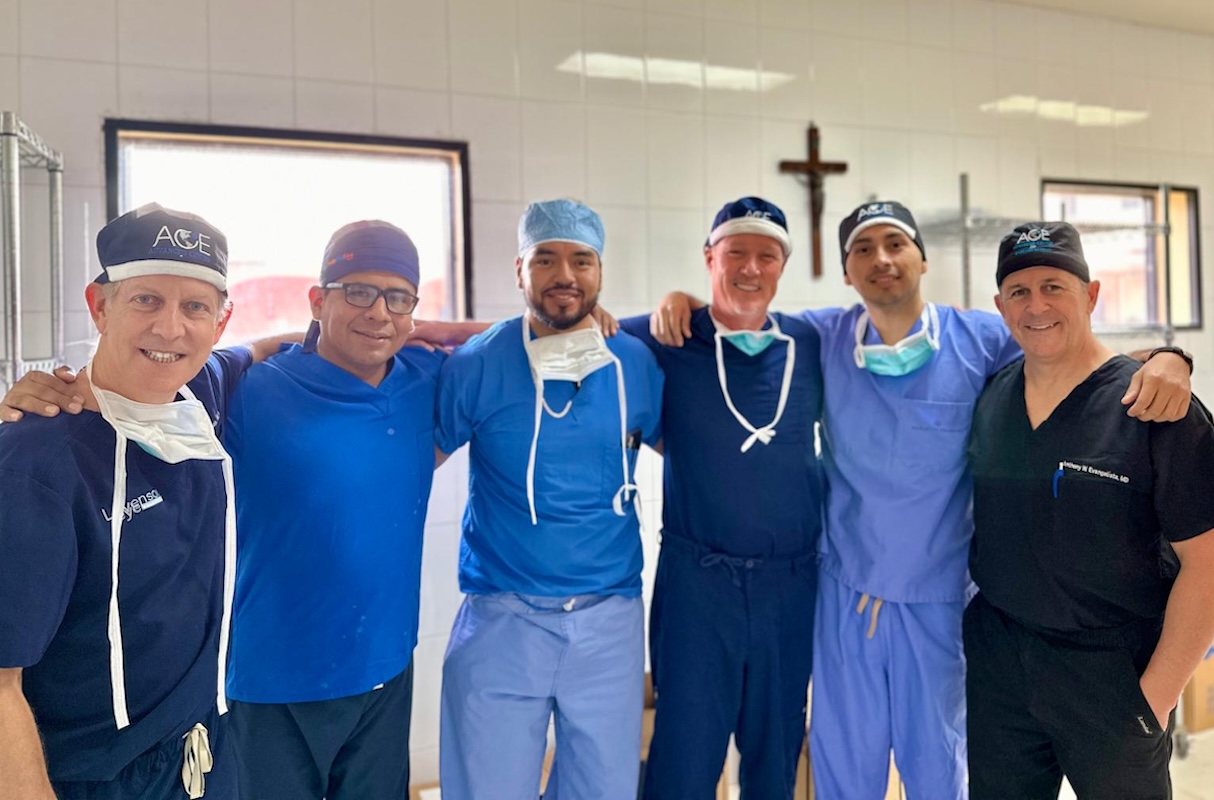 Photo: Emory Eye Center alumn, Dr. Jeff Levinson, mentoring three fellows from Bolivia, Argentina and Mexico.
Partnership with Emory Physicians
A cornerstone of ACE Global’s growth has been its collaboration with Emory University and its physicians. Many of Barber’s own colleagues and former mentors have returned to volunteer, lending their expertise not only in surgery but also in teaching. Early supporters included Emory residents and fellows who joined cataract missions, later transitioning into ACE Global’s training model by mentoring young surgeons directly. Today, dozens of Emory faculty members contribute to this effort, often spending one to two weeks in Honduras sitting beside fellows in the operating room, guiding them through complex cases.
“It’s one of the highlights of this process, this program has been our strong partnership with Emory. The Emory Global Ophthalmology Fellows, they'll go down and they're not just there for a week or two. They'll go down for months. They really can be like our eyes on the ground.”
This model of service has expanded the reach of Emory’s global ophthalmology footprint. “Instead of performing surgeries themselves, these physicians are imparting skills that last a lifetime,” Barber said. “Their willingness to give time, share knowledge, and adapt to resource-limited environments has been central to our success.”
By mobilizing physicians who once participated in short-term missions, ACE Global has created a sustainable, faculty-driven system of mentorship. The commitment of Emory volunteers reflects not only personal dedication but also the institution’s broader investment in global education and health equity.
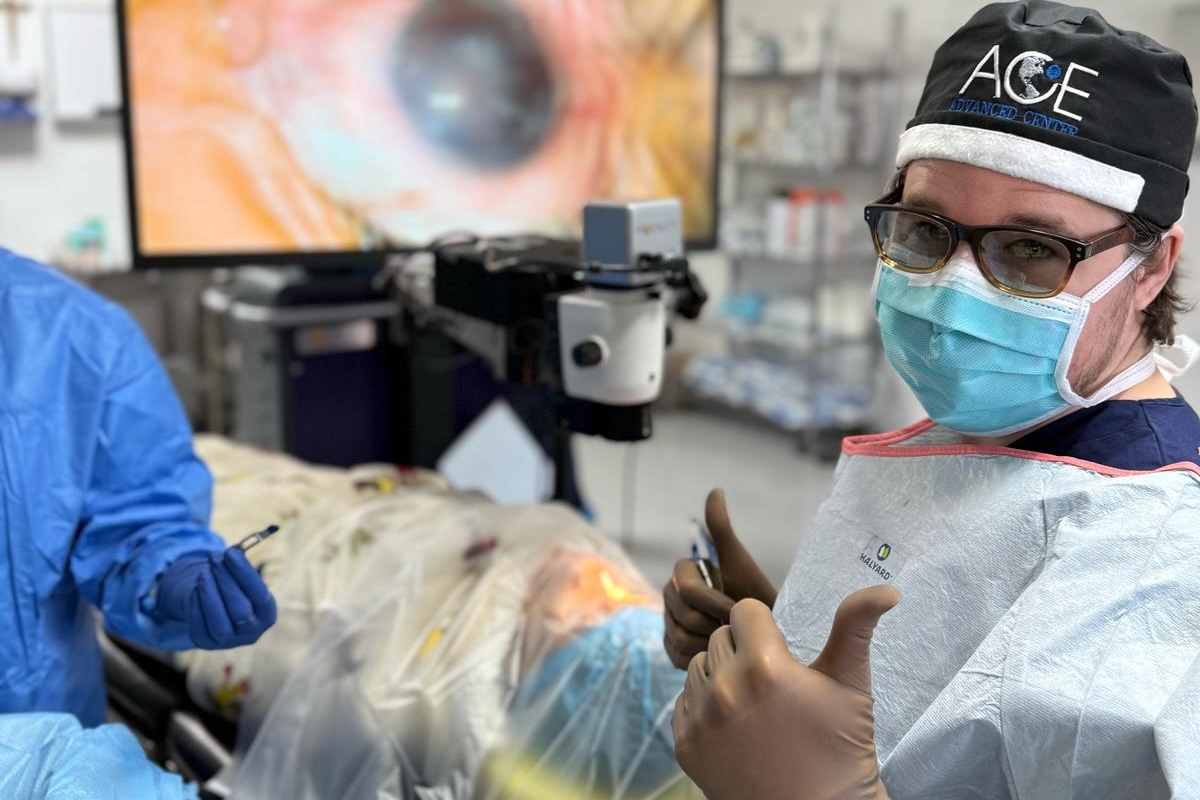 Photo: Emory 2025 Global Fellow, Dr. Patrick Wurster, teaching phaco and clinical skills to the ACE G fellows. In return he was taught the MSICS surgical technique by the past Honduran fellows.
Building Academic Exchange
“I came out of my experiences realizing that the best thing that we could do is provide training and teaching. because that's what we're gifted with. I mean, we're, we have incredible academic centers like Emory. You know, I was in incredibly blessed to have the education I received, and that's one of the biggest assets that we can give.”
Through the leadership of Dr. Jacquelyn O’Banion and the Emory Eye Center’s Global Ophthalmology program, Emory fellows have joined ACE in Honduras, serving on the ground for extended periods. Their presence has strengthened oversight, facilitated cross-cultural exchange, and provided critical feedback for program development. Conversely, ACE fellows rotate through Emory and Grady, gaining exposure to advanced systems of care in the United States.
The results are significant. ACE Global anticipates performing 3,000 cataract surgeries in Honduras this year alone through its training program. More importantly, Honduran ophthalmologists trained by ACE are now serving as educators, gradually reducing reliance on outside volunteers and fostering academic independence.
The next phase of growth is a 20,000-square-foot training center in Honduras, complete with operating rooms, teaching laboratories, and residential accommodations for visiting faculty and fellows. In a deliberate departure from traditional international aid models, the facility will be owned and operated by ACE Global Honduras, a nonprofit governed by Honduran physicians. This approach ensures local leadership, accountability, and long-term stability.
“This is not about an American institution controlling a hospital abroad,” Barber emphasized. “It is about equipping Honduran physicians to create a self-sustaining academic and clinical system for their country. Our role is to support and eventually step aside.”
As ACE Global strengthens its work in Honduras, attention is turning to future replication in other countries. Fellows from Mexico, Guatemala, El Salvador, Argentina, and Bolivia have already trained with the program and are requesting similar initiatives in their home nations. Barber envisions a gradual expansion, guided by established partnerships and the principle of sustainable development.
For Barber, the mission remains grounded in the human impact. He recalls the profound expressions of patients seeing their families or the natural world again after years of blindness—moments that first drew him into global health and continue to drive his work today.
“Watching a young surgeon evolve into a skilled physician capable of restoring sight in a community with no other options—that is the true measure of progress,” he said. “It is how we build lasting change.”