


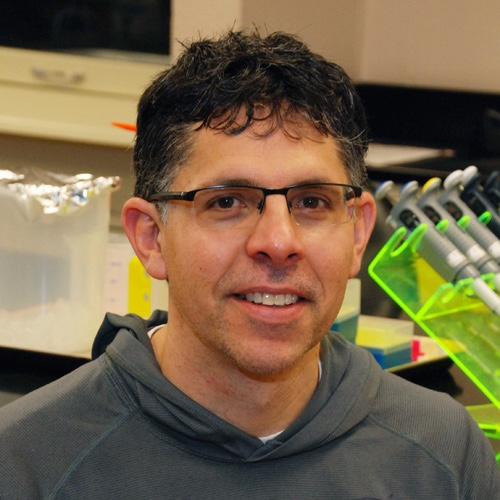
Dr. Ciavatta, an instructional specialist in Emory University’s biology department, plays a key role in shaping undergraduate lab education. His work involves preparing lab spaces, troubleshooting protocols, and developing new modules that encourage students to engage with scientific inquiry beyond standard procedures. His teaching has spanned multiple institutions over his career, including at Emory, Georgia Institute of Technology and Morehouse College, reflecting his commitment to building research skills in early-stage scientists and undergraduates.
“My mother was a big influence on me, in instilling appreciation in science, math and technology. She’s a nurse and I think her passions really rubbed off on me, and I gravitated to that.”
His academic journey began with a degree in biochemistry, followed by a master’s in engineering and a PhD in plant science. A diagnosis of retinitis pigmentosa (RP) during his doctoral studies prompted a shift in focus from plant biology to vision research. This led him to Emory’s Eye Center, where he completed a postdoctoral fellowship within the vision research lab, run at the time by Dr. John Nickerson.
Though his research career included work at the VA and in neuroscience labs, Dr. Ciavatta eventually transitioned to his current instructional role. Supporting the teaching labs within Emory’s biology department, looking at microbial ecology and microbiology – he makes sure the labs run smoothly and to the students’ educational benefit.
“I focus on teaching and supporting lab-based learning.” The move marked a shift from clinical research to foundational biology, with a focus on education rather than publication. With his condition, he reflects that “it’s becoming more difficult to navigate and get around, there’s a lot of uncertainty in it, so as far as day to day, the position works now, but I know it will need to change.”
Navigating Science with Visual Impairment
First diagnosed with RP at the age of 26, Dr. Ciavatta is now 55 and navigating his environment alongside consistently increasing vision loss – with no current cure for the condition.
Living with a visual impairment presents logistical challenges, particularly in terms of mobility. Dr. Ciavatta has not driven since 2006 and commutes by bicycle. In the classroom, he uses his perspective in providing an inclusive environment for Emory students, ensuring he is aware and addressing their accommodation requirements in the labs as needed.
“There’s a mental load,” he explains, describing how navigating everyday environments requires constant attention, “like when a normally sighted person walks down the street, they’re on autopilot, whereas on a busy street I need to be careful and it takes the majority of my brain space to navigate smoothly from A to B.” He brings this unique experience to his current role administering the biology labs and helping to ensure students partake in instructive and exciting research.
Inclusion in Scientific Research
“I come from biological research, and from that perspective, I believe one of the backbones or tenets of biology is that diversity is important for an ecosystem.”
Dr. Ciavatta emphasizes the importance of inclusive research environments, he notes: “Diversity is important. If research is conducted only by able-bodied individuals, the field may lack the range of perspectives needed to address complex problems.” Inclusion, he argues, strengthens the scientific process by broadening its scope and applicability.
He also highlights the role of research in shaping clinical outcomes. Cataract surgery and treatments for macular edema have directly impacted his own vision. “These procedures and treatments exist because of research,” he says. “That fact shouldn’t be taken for granted. It may seem arduous, but knowledge and procedures that improve lives depend on consistent training and research.”
Dr. Ciavatta encourages policymakers to recognize that scientific progress is often incremental. “Breakthroughs are built on years of foundational work,” he explains. “The process is methodical and requires sustained investment.” He likens this to the concept of punctuated equilibrium in evolutionary biology — long periods of gradual change followed by significant developments.
Looking Ahead
“In terms of reflecting on disabilities, I can only speak towards mine. From my experience, you get to the clinic, you get told that you have a visual impairment that’s going to progress – and there’s no treatment. There are constant challenges, but if there’s work going towards it then there is at least some bit of hope.”
As the population ages and conditions like age-related macular degeneration become more common, Dr. Ciavatta believes that investment in vision research will remain critical. His perspective underscores the practical value of research — not just as a tool for discovery, but as a mechanism for addressing real-world challenges, and, providing solutions for those that critically need them