


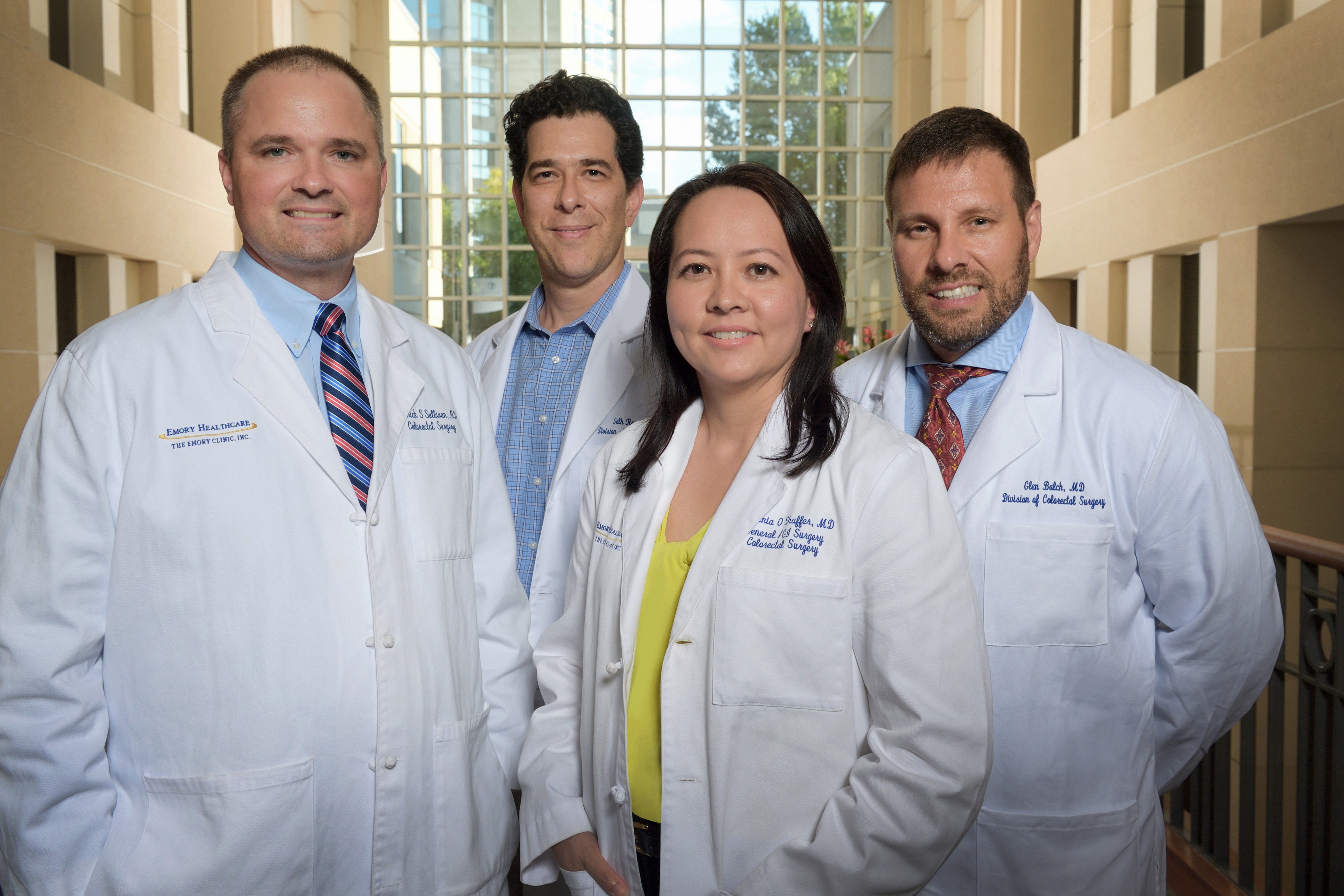
Overview
Current projects include investigating methods of refining specific treatments for inflammatory bowel disease patients; defining any barriers to implementing Enhanced Recovery after surgery (ERAS) protocols throughout the Department of Surgery; evaluating novel imaging techniques to improve the accuracy of clinical staging for rectal cancer; and examining novel medications to determine their ability to improve response rates, local recurrence, and survival of rectal cancer patients.
Robotic Research Fellowship
The Division of Colorectal Surgery offers a Robotic Research Fellowship. For more details, see the link above.
Investigators
Ellen Caparosa, MD
Driven by an interest in translational oncology, Dr. Caparosa is dedicated to refining the therapeutic landscape of colorectal cancer care by investigating the critical interactions between the host immune system and tumor cells. Her current research centers on exploring regional immune responses and understanding how distinct cellular environments can be leveraged to optimize targeted treatments. The ultimate goal is to translate these insights into novel therapeutic approaches that improve patient survival and recovery—reflecting a broader commitment to advancing clinical outcomes and quality of care for all colorectal patients.
Adekemi Egunsola, MD
Dr. Adekemi Egunsola is an Assistant Professor in the Department of Colon & Rectal Surgery at Emory University who is clinically based at Grady Memorial Hospital. Her work focuses on improving surgical care delivery and patient outcomes through outcomes-based and disparities-focused research. Her academic interests include evaluating quality metrics, access to care, and healthcare inequities affecting patients with colorectal diseases, particularly among underserved and vulnerable populations. Through collaborative clinical and translational research, she aims to identify strategies that improve equity, optimize perioperative outcomes, address patient quality of life, and advance evidence-based colorectal surgical care. In addition to her research efforts, Dr. Egunsola is committed to surgical education, mentorship, and providing high-quality patient-centered care within a safety-net hospital.
Karishma Kodia, MD
With a background in clinical outcomes research, Dr. Kodia focuses on leveraging large-scale databases and patient outcomes to better understand and improve cancer care delivery. Her interests center on young-onset colorectal cancer, an area of growing clinical concern with distinct biologic and epidemiologic patterns and associated systems in place for access, financial toxicity, and palliative care outcomes. She is also engaged in quality improvement initiatives aimed at optimizingcare processes and enhancing patient outcomes, aiming to advance more personalized and patient-centered care.
Terrah Paul Olson, MD
Terrah Paul Olson is an assistant professor with the Division of Colorectal Surgery. Her current and ongoing research interests include surgical outcomes in malignant bowel obstructions and improving discussion of goals of care in patients with advanced intra-abdominal malignancies; anogenital dysplasia in patients with inflammatory bowel disease; and objective performance indicators in robotic colorectal surgery. She is also involved with quality improvement and systems for patient safety and quality. Her prior research experience includes work with murine models of colorectal cancer as well as survey base research studying conflict in the ICU.
Ari R. Reichstein, MD, MPH
Dr. Reichstein's research examines the financial and structural dimensions of surgical care — how insurance coverage, geography, and institutional setting shape which patients reach treatment, what that treatment costs them, and who absorbs the burden when systems fall short. Colorectal cancer serves as the primary clinical model for this work, with a particular interest in patients whose disease or circumstances place them outside the assumptions of conventional care pathways.
His current projects explore the use of qualitative as well as quantitative methods to characterize the financial consequences of surgery for colorectal cancer, including questions about catastrophic expenditure and the downstream effects of shifting coverage policy. His training in bioethics and public health supports a portfolio of interest spanning health services research, surgical quality, and the ethics of healthcare market dynamics.
Seth Rosen, MD
Dr. Rosen is the Director of Research for Emory’s Division of Colorectal Surgery. His research efforts focus largely on robotic colorectal surgery, with specific lines of investigation into surgical quality, procedure complexity and workflow, andsurgical training. Dr. Rosen is considered a leader in the field of Surgical Data Science, and his research team has published multiple pioneering studies on the use of objective performance indicators to assess surgeon expertise, surgery complexity and trainee benchmarking.
Dr. Rosen has also contributed to our understanding of surgeon learning curves during robotic colorectal surgery as well as the impact of robotic surgery in the care of patients with colorectal cancer and diverticulitis. His work regarding robotic surgery privileging and credentialing has informed institutional and national efforts to standardize requirements for robotic surgeon credentialling.
Dr. Rosen is a member of the Cancer Prevention and Control Research Program of Winship Cancer Institute, which is dedicated to reducing cancer risk, incidence, morbidity, and mortality, and is striving to improve the quality of life of cancer patients and survivors in Georgia and beyond.
Celine R. Soriano, MD
Dr. Soriano is actively involved in clinical research with particular emphasis on health services research, patient outcomes, and quality improvement initiatives in colorectal surgery. Her research interests center on optimizing perioperative care and improving access to high-quality surgical treatment for patients with both benign and malignant colorectal disease. She is involved in projects evaluating enhanced recovery after surgery (ERAS) protocols in patients with inflammatory bowel disease, examining disparities in access to colorectal cancer surgical care, and advancing multidisciplinary approaches to screening, surveillance, and cancer prevention for patients with hereditary colorectal cancer syndromes.
In addition, Dr. Soriano has a strong interest in minimally invasive and robotic colorectal surgery, with a focus on innovative surgical techniques and the integration of emerging technologies to improve patient outcomes. She is also passionate about surgical education and is engaged in the development of video-based educational resources and operative teaching tools for trainees and practicing surgeons.
Patrick Sullivan, MD
Dr. Sullivan is a colorectal surgeon and outcomes researcher with a primary focus on rectal cancer. His research centers on optimizing nonoperative management strategies, particularly evaluating surveillance compliance and long-term outcomes in patients undergoing watch-and-wait after total neoadjuvant therapy (TNT). Dr. Sullivan is interested in better defining recurrence patterns among patients with complete and near-complete clinical responses, with the goal of improving patient selection, surveillance protocols, and oncologic outcomes.
In addition to rectal cancer, Dr. Sullivan has a developing interest in colorectal neoplasia in endurance athletes, specifically examining the potential relationship between long-distance running and colorectal pathology.
Dr. Sullivan’s broader goal is to translate clinical outcomes data into actionable strategies that improve quality, access, and value of care. He is particularly interested in collaborating with multidisciplinary partners in oncology, epidemiology, and health services research, and in recruiting trainees and junior faculty interested in clinical outcomes, cancer quality, and data-driven surgical research.
Abhineet Uppal, MD
Dr. Uppal’s research focuses on the development of algorithms to identify early post-operative complications after gastrointestinal surgery using laboratory and vital sign data. Additionally, Dr. Uppal works with the Winship Cancer Center to develop comprehensive data collecting algorithms to monitor the treatment progress and outcomes of cancer patients.