
What to Expect in the Human Simulation Education Center
Rooms
The Clinical Skills Center consists of 16 exam rooms in four suites (308, 310, 320, & 322) located on the 3rd floor of the medical school building. Each suite has a central small group/debrief room and 4 exam rooms equipped as a doctor’s office or clinic exam room might be.
Attire
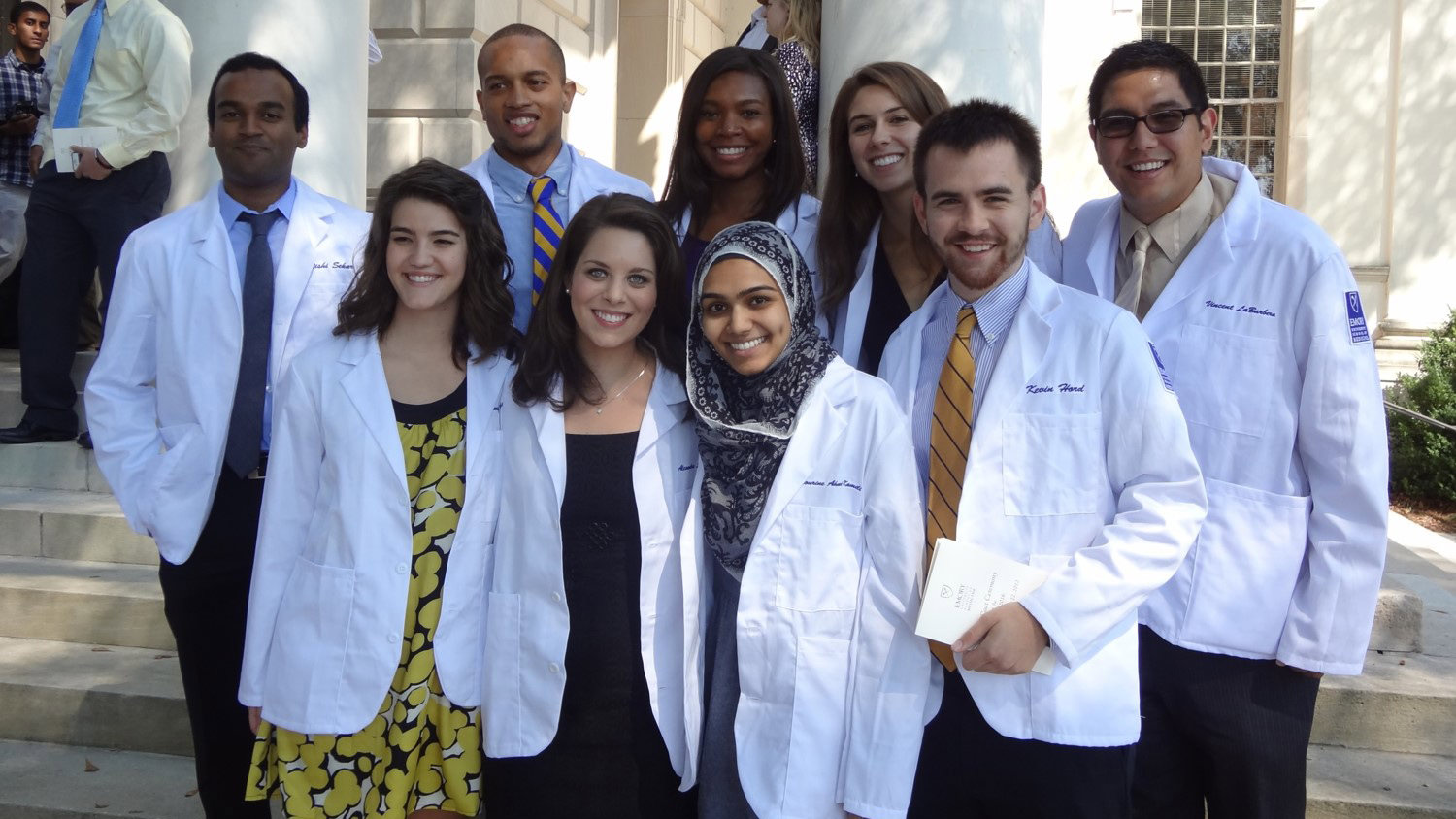
Professional attire appropriate for seeing patients and a clean, white coat are expected when seeing patients in the Human Simulation Education Center. Bring your stethoscope with you!
Equipment & Supplies
Each exam room is equipped with an ophthalmoscope/otoscope/BP/thermometer wall unit. Tongue depressors, cotton swabs, cotton balls, tuning forks, a reflex hammer and gloves are standard supplies in each room. Unless otherwise instructed, all you’ll need to bring with you is your stethoscope.
Simulated Patients
Simulated Patients (SPs) are typically part of encounters in HSEC. An SP is a person who has been trained to portray a patient with an illness or medical condition and to do so in a standard, reproducible way with each learner. Working with SPs presents a unique opportunity to practice various clinical skills in a controlled environment without having to worry about potential harm to a patient. SPs can also provide you with objective and unbiased feedback.
SPs have been trained to expect the same treatment from you as if they were an actual patient (with a few exceptions) and they will interact with you accordingly. We aim for authenticity so that patient experiences in our center will accurately reflect a real clinical experience.
Interacting with Simulated Patients
The SP will remain in character throughout the encounter. Most often they will play a patient you are meeting for the first time. Your role will be clearly defined in the instructions you receive about specific events.
Encounters with Simulated Patients
A typical encounter with an SP may involve interviewing, counseling, examining and/or treating a patient in the same manner as would occur during an actual clinical encounter. However, unlike many student experiences, there is no team or attending with whom to consult. You will need to commit to a diagnosis (or differential) and plan without use of any resources, human or otherwise. In these encounters, it is up to the student to decide what questions need to be asked and what body systems need to be examined.
Recordings
All encounters in HSEC are recorded and an automated software program called Learning Space runs the recording equipment. Most are recorded with video, some with sound only. The recordings are pre-programmed and scheduled, therefore students cannot switch places with peers, and if you are late, the event cannot be delayed for you. Contact your coordinator in case of emergencies to see what can be worked out.
Objective Structured Clinical Exams (OSCEs)
OSCEs are defined as:
• An approach to the assessment of clinical or professional competence in which the components of competence are assessed in a planned or structured way with attention being paid to the objectivity of the examination (Harden, 1988).
• A station or series of stations designed to assess performance competency in individual clinical or other professional skills. Learners are evaluated via direct observation, checklists, learner presentation, or written follow-up exercises. The examinations may be formative and offer feedback or summative and be used for making high stakes educational decisions (Association of Standardized Patient Educators).
• A method of assessment where learners perform specific skills and behaviors in a simulated work environment.
OSCEs can be found throughout the curriculum. The medical students participate in a high-stakes OSCE at the end of foundations (EOF) and another at the end of applications (EOA).
Other SP Activities
MD students will also encounter SPs throughout their Essentials of Patient Care curriculum, and during many of their clerkship rotations. Some of these will be formative, others summative. Some will resemble typical OSCEs, and in others there will be differing objectives.
The term OSCE is frequently used to mean any SP encounter, so while some SP activities aren't technically OSCEs, this term may be used.
Physician assistant, physical therapy and genetic counseling students have SP activities in our center at various points throughout their curricula, as do several graduate medical education programs.
Case Development
Cases and checklists are developed by faculty, clinical staff, and HSEC staff, and are typically based on real cases they have encountered. We intend all cases used at HSEC to be appropriately challenging for the learners at their current level, and aligned with the learning objectives of the activity.
Debrief and Feedback
Feedback may come from faculty, SPs, both or neither. It may be verbal and/or written depending on the objectives of the event. Not all events will involve feedback.
SPs have been trained in a Socratic method of debrief, in which they ask the learner about their thoughts and feelings on the encounter. The SP feedback will typically focus on communication and bedside manner. We prefer to call these sessions "verbal debriefs" instead of feedback sessions, because the focus is on guiding the learners to their own realizations for self-assessment and self-improvement.
Faculty feedback typically focuses on the medical aspects of the encounter – history taking, physical exam skills, medical knowledge and critical thinking.
Tips for a Successful SP Experience
- Treat the encounter like an actual patient encounter.
- Be yourself! Embody all the traits and behaviors that will make you a uniquely good provider.
- Ask any question you'd ask a patient in such an encounter--if it's a reasonable question for a provider to ask a patient, our SPs are prepared to answer it.
- Actually examine the patient, don't just go through the motions. To be given an abnormal finding, you often need to thoroughly examine. SPs are trained not to give away findings if the learner's exam technique doesn't meet the standard set by The Emory Way.
- Don't break the reality of the encounter until the case is over.
- Keep your focus on the patient. The goal of an actual patient encounters are centered on the patient's needs; while the goal of encounters at HSEC are centered on your educational needs. This creates a bit of a paradox where it's easy for learners to become self-focused, but to achieve success, you need to practice that patient-centeredness.
- Understand that challenges and struggles can be a path to learning, and give yourself grace for anything that doesn't go well.
Learning Space Access & Instructions
You can review many of your recent encounters by accessing our LearningSpace software. LearningSpace is housed on the intranet so when off-campus, you need to use the VPN in order to access it. https://it.emory.edu/vpntools
For instructions to access LearningSpace, go here.