2026 Emory 3D Symposium: The Future of Therapeutic Innovation
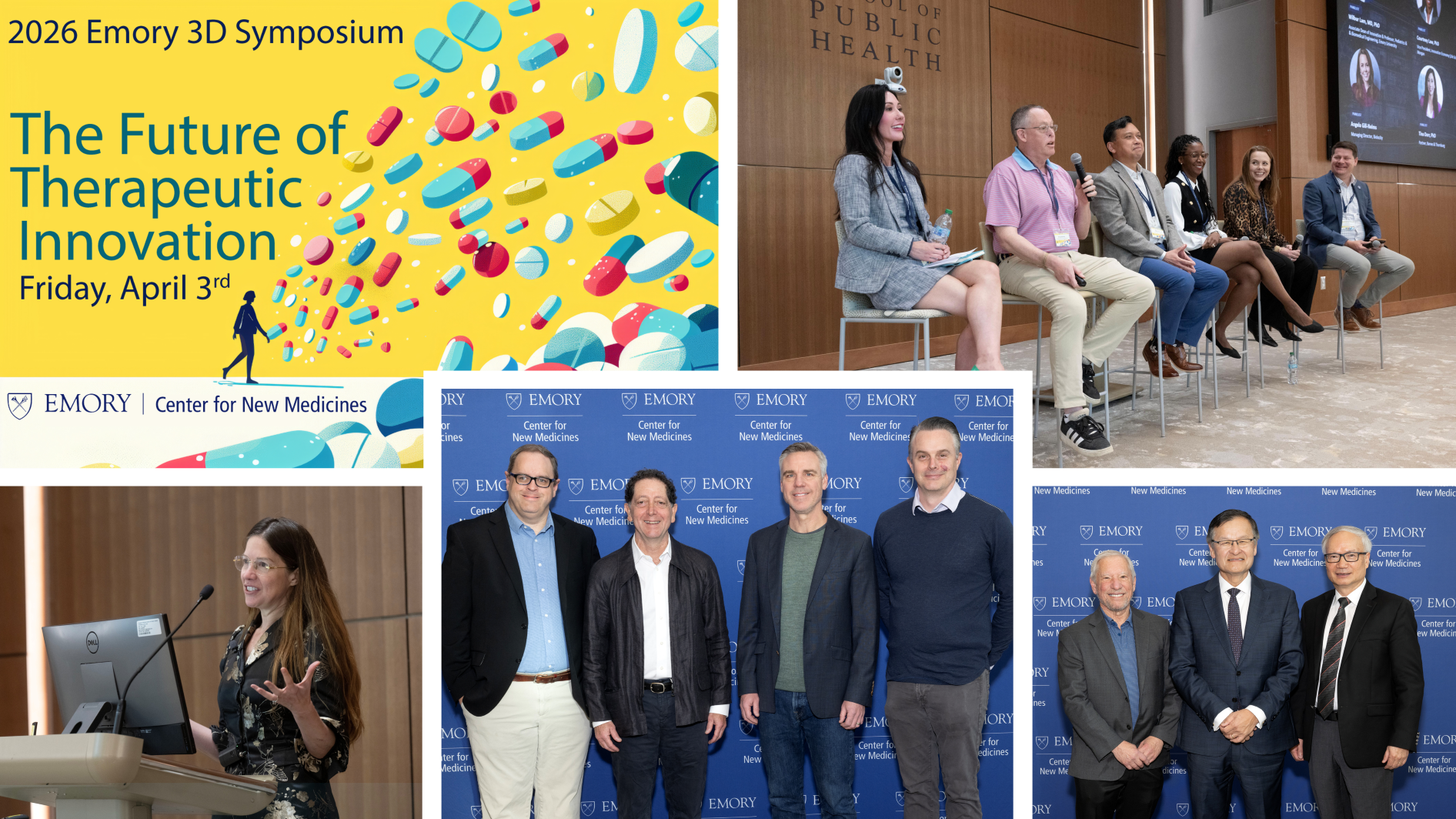
On Friday, April 3rd, the Emory Center for New Medicines (CNM) hosted its third annual 3D (Drug Discovery and Development) Symposium.
Centered on the theme, The Future of Therapeutic Innovation, the day’s program featured talks and discussions around the various modalities, targets and models shaping the future of drug discovery. The event drew 258 registrants from more than 20 departments across Emory, a reflection of the depth and diversity of engagement across the Emory community.
The day kicked off with opening remarks from Joon Lee, MD, Executive Vice President for Woodruff Health Sciences, who highlighted the importance of integration across Emory’s research and healthcare communities. Highlighting CNM’s central tenet of supporting bidirectional translational research, he emphasized that such a uniquely interconnected ecosystem serves as a strong foundation for translating innovative Emory discoveries into new therapies for unmet medical needs.
The scientific program began with a keynote presentation by Kevan Shokat, PhD, Professor in the Departments of Cellular and Molecular Pharmacology, UC San Francisco, and Chemistry, UC Berkeley, and Investigator, HHMI. His talk on Overcoming the Undruggable Nature of the Most Common Human Oncogene, K-RAS offered incredible insights into his breakthrough discovery of the first covalent K-RAS G12C inhibitor, and the subsequent use of innovative chemical approaches to expand this work to target other, disease relevant, mutant K-RAS variants (e.g., G12D). Mutations in the K-RAS oncogene, long considered undruggable, are highly prevalent across multiple cancer subtypes and have historically been associated with poor responses to standard therapies. However, the advent and clinical translation of mutant selective K-RAS inhibitors have the potential to significantly alleviate disease burden for millions of cancer patients.
Continuing the theme of therapeutic innovation, the keynote was followed by a series of featured talks spanning small molecule RNA and protein degraders, to biologics and cell-based therapies:
Matt Disney, PhD, Institute Professor and Chair in the Department of Chemistry at the Herbert Wertheim UF-Scripps Institute for Biomedical Research & Innovation, delivered a talk on Covalent Approaches to Study RNA-Small Molecule Interactions. His presentation highlighted the use of covalent probes to elucidate the mechanism of action of Merafloxacin, an inhibitor of the SARS-CoV-2 frameshifting element, a highly structured RNA sequence in the viral genome. Disney is widely regarded as a pioneer in the discovery of RNA-targeting small molecules, a field which defies traditional drug discovery dogma.
Disney also served as the keynote speaker for our inaugural trainee symposium. This doorstep meeting, which convened a diverse group of Emory undegraduates, graduate students and postdocs around the theme of Drugging the Undruggable took place the day before 3D.
Ryan Potts, PhD, Vice President of Research and Head of Amgen’s Induced Proximity Platform, presented Any Target, Every Time: How Proximity-Based Therapeutics Has Redefined Druggability. His talk emphasized the utility of induced proximity agents – molecular “matchmakers” that bind both a target protein and an effector, overcoming the randomness of molecular encounters to bring these into proximity and form non-native complexes – in expanding the drug discovery arsenal. Examples ranged from molecular glues targeting new effector proteins (e.g., VHL), and disease- or region-specific targeted protein degraders (e.g., VIPER-TACs, LYMTACs), to sustained proximity drugs (e.g., LOCKTACs) able to lock macromolecular complexes into stable, non-functional assemblies. Under Potts' leadership, the induced proximity platform team at Amgen is leveraging these novel multispecific molecules to pursue the 85% of proteins and other molecules historically considered undruggable.
Eric Sundberg, PhD, Professor and Chair in the Department of Biochemistry at Emory, spoke on Editorial Control of the Human IgG Glycome. His presentation showcased his research on bacterially derived IgG-specific endoglycosidases as a safer and more selective treatment option for IgG-mediated diseases, including autoimmunity. Unlike approved “IgG degraders” (e.g., VYGART® and Idefirix®), which indiscriminately eliminate circulating IgG and compromise immune function, Sundberg’s “IgG defeaters” instead modify IgG while retaining its neutralizing capacity. On April 2nd, Sundberg received Emory’s Office of Technology Transfer’s (OTT) “Deal of the Year” award in recognition of a high-value licensing agreement executed in 2025 with Rhapsogen, an Emory start-up company co-founded by Sundberg to advance this innovation.
Chrystal Paulos, PhD, David H. Lawson Professor in Cancer Research and Professor in the Departments of Surgery and Microbiology & Immunology at Emory, presented Programming T Cells for Cancer Therapy: Turning Immune Cells into Living Drugs. Her talk highlighted how human T-helper 17 (Th17) cells, an underexplored subtype of T-cell for Adoptive T-cell Transfer (ACT) therapy, can elicit potent and sustained tumor killing through interactions with B-cells, underscoring their therapeutic potential in cancer patients. Paulos’ work has demonstrated promise as a next-generation ACT for advanced melanoma patients who are resistant to immune checkpoint blockade (ICB) therapy, accounting for 40-60% of advanced melanoma patients.
The afternoon’s scientific sessions culminated in an inspiring panel discussion hosted by Justin Burns, Chief Innovation Office and Vice President of Innovation & Entrepreneurship at the Georgia Research Alliance. Focused on The Future of Therapeutics in Atlanta, this lively discussion brought together leaders from across Atlanta’s growing biotech ecosystem. Panelists included:
Tina Dorr, PhD, Partner at Barnes & Thornburg
Angela Gill-Nelms, Managing Director of Biolocity
Doug Gooding, Managing Director, Emory Drug Discovery Fund and CEO, DRIVE Therapeutics
Wilbur Lam, MD, PhD, Associate Dean of Innovation and Professor in the Departments of Pediatrics and Biomedical Engineering at Emory University
Courtney Law, PhD, Vice President of Innovation Economy (Life Sciences) at J.P. Morgan
In discussing the future of therapeutic innovation in Atlanta, the panelists - largely echoing the opening remarks by Joon Lee - stressed the importance of synergy across departments and institutions. To help overcome the valley of death in academic drug development, they noted that researchers should strategically leverage the enabling resources and expertise available across the university network; at Emory, this includes access to our extensive healthcare system and OTT. Once again, these themes closely align with CNM’s goal to foster a therapeutic innovation ecosystem through strategically integrated operations and cross-cutting support mechanisms across Emory.
In closing, Sandra Wong, MD, MS, Dean of Emory University School of Medicine, reinforced the day’s key takeaway: collaboration and connection are essential to enabling innovative therapeutic discoveries to move from bedside to bench, and back again.
Following Dean Wong’s inspiring remarks and call to action, attendees then enjoyed a reception to allow for meaningful conversations and networking within our robust drug discovery community.